What Are Forged Pistons and Why Should I Care?
If you spend any time around performance engines, engine builds, or even just browsing online forums, you’ve probably heard the term forged pistons. It’s one of those phrases that gets thrown around a lot, usually alongside horsepower figures, turbo upgrades, or “built engines”, but not always properly explained.
So let’s break it down in a way that actually makes sense, without the marketing noise, and with some real world engineering perspective.
First things first: What is a forged piston?
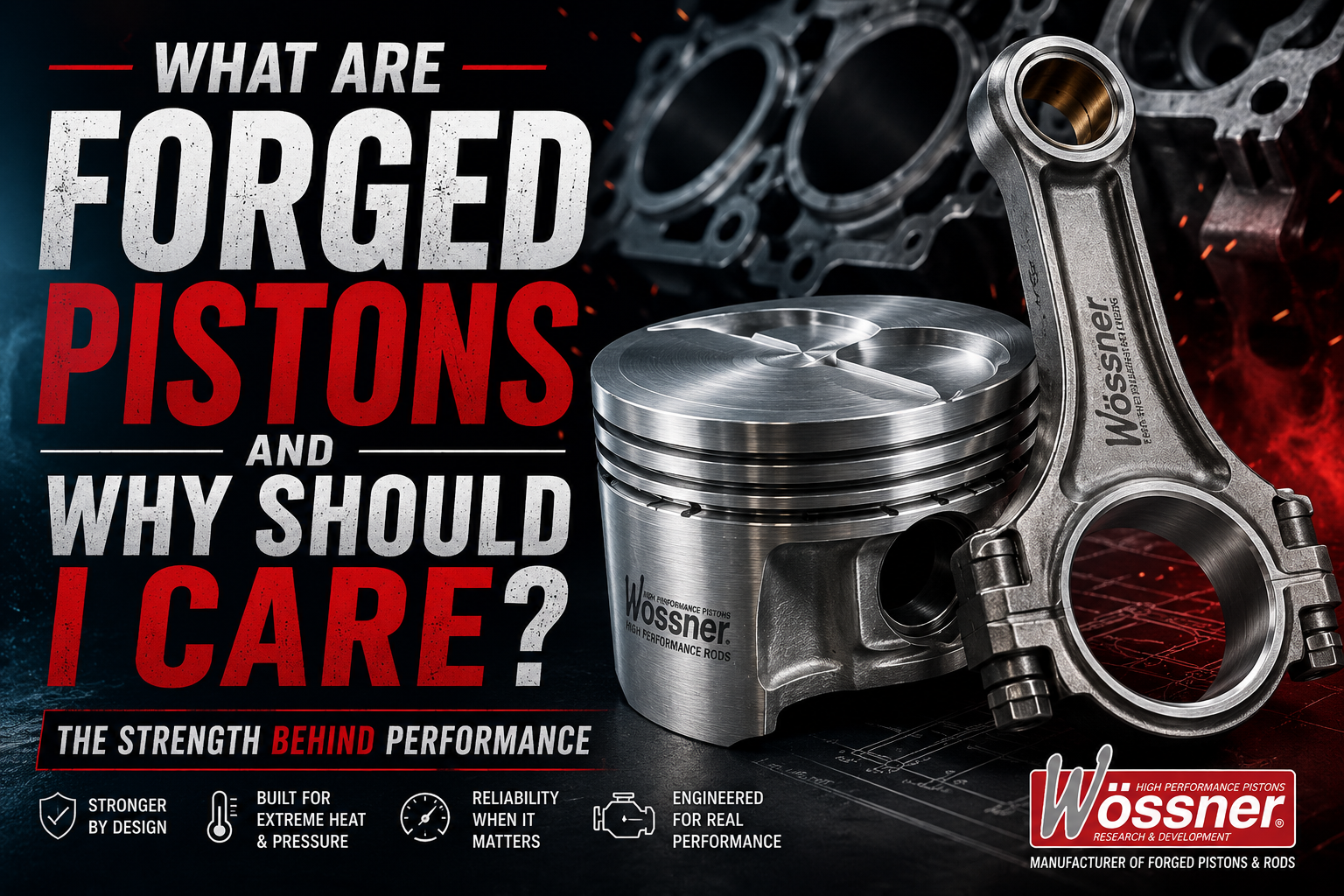
A forged piston is a piston that’s made by taking a solid billet or ingot of aluminium alloy and forming it under extreme pressure. Instead of pouring molten metal into a mould (like a cast piston), the material is literally squeezed into shape.
That forging process matters because it changes the internal structure of the metal. The grain flow becomes aligned and compressed, making the component stronger and more resistant to stress.
A simple way I often explain it is this: Casting is like pouring batter into a cake tin. Forging is like compressing and working the dough so everything is tightly packed and stronger.
Both make a piston, but they behave very differently once the engine starts producing heat, pressure, and load.
My background and why this matters
Before moving into my role as Sales Manager for Wössner UK, I spent years as a CNC machining engineer. I’ve worked on everything from machining cylinder heads and blocks for engine rebuilds to skimming brake drums for classic Jaguar race cars and fabricating custom components for restorations where parts simply no longer exist.
That experience gives you a very clear understanding of one thing:
Engines and components don’t usually fail randomly, they fail because something was pushed beyond its limit.
And pistons are often right at the centre of that limit.
What goes wrong with standard (cast) pistons?
In performance or high stress environments, I’ve seen a consistent pattern of failure with cast pistons:
- Cracked ring lands from detonation
- Cracked piston skirts under load
- Pin bosses failing mid race
- Bent connecting rods following piston failure and seizure.
Some of the most dramatic failures I’ve seen happened in motorsport environments, where an engine failure doesn’t just mean inconvenience, it can mean losing a race or a round entirely.
In many cases, the piston isn’t the only casualty. Once a piston lets go, it can take the block, rods, valvetrain and even the crankshaft with it.
That’s why material choice and build strategy matters so much.
So what do forged pistons actually improve?
Forged pistons are stronger, but not in a “magic bulletproof engine” way.
The real advantage is tolerance under stress:
- Higher resistance to detonation damage
- Better durability under boost or high compression
- Improved survival under sustained high load
- Greater safety margin in performance applications
From my experience at Wössner UK, one of the biggest misunderstandings is that people think:
“If I fit forged pistons and rods, my engine is now indestructible.”
That’s not how it works.
A forged piston and connecting rod package is not a fix for a weak engine, it’s a component upgrade within a system. The engine still needs correct supporting modifications, proper machining, and most importantly, correct tuning.
Real-world applications and case studies
We’ve supported a wide range of performance builds across both automotive and motorcycle applications.
That includes:
- Record breaking motorcycles running on the salt flats (BMW 1938 RS 500c Bonneville racer)
- Drift cars competing at high level motorsport events ( BDC, Drift Pro, Drift league and many Exhibitions)
- Drag cars chasing improved quarter-mile times (Santa Pod Doorslammers is a great place to see this in action)
In each of these environments, forged components are not used in isolation. They are part of a wider performance package designed to manage increased stress safely.
One common theme across all of them is simple: reliability under sustained load is what wins events, not just peak horsepower numbers.
The biggest myth about forged pistons
The most common misconception I hear is:
“Forged pistons will make my engine bulletproof.”…………..They won’t.
What they will do is increase your engine’s ability to survive higher stress levels, but only if the rest of the engine is built to match.
That includes:
- Correct oil system performance
- Adequate cooling
- Proper machining tolerances
- And absolutely critical: ECU tuning
I often explain it like this:
The engine is the body, the pistons and rods are the muscles, but the ECU is the brain.
Without correct tuning, even the best hardware will fail. I’ve seen people spend thousands on forged internals only to lose engines because the tuning and calibration was wrong or incorrectly set up.
When are forged pistons actually worth it?
Every engine has limits on stock internals. The real question is how far you’re willing to push those limits.
Once you increase power, boost, or cylinder pressures, you also increase stress on every internal component.
At that point you have two choices:
- Stay within safe OEM limits
- Or build the engine to handle more load
But it’s not always about extreme power. I also know customers who fit forged pistons purely for peace of mind while running stock horsepower.
There isn’t a single correct answer, it depends entirely on the application and how the engine will be used.
If you push too far without upgrading, you risk far more than just piston damage. You could end up replacing the crankshaft, rods, or even the entire block, and that’s where costs escalate quickly.
What you should focus on when choosing forged pistons?
If you’re considering a forged piston setup, the key areas I always advise people to think about are:
- Piston sizing and correct application fitment
- Whether the cylinders need machining or re-boring
- Compression ratio and how it affects performance goals
- Supporting modifications (fuel, cooling, oil system)
- ECU tuning and calibration quality
This last point cannot be overstated. The best engineered parts in the world will not compensate for poor tuning.
My final thoughts
Forged pistons are not about turning a standard engine into an indestructible powerhouse overnight.
They are about building a stronger foundation for controlled performance increases, whether that’s for racing, tuning, or simply reliability under higher stress.
From my engineering background through to my current role at Wössner UK, I’ve seen both sides of this repeatedly: engines that succeed because they were properly built as a system, and engines that fail because one part was upgraded without the rest of the package being considered.
If there’s one takeaway, it’s this:
Forged pistons don’t replace good engineering, they enhance it when everything else is done correctly.
Now go out there and enjoy your engines whatever they may be!
Matthew Green
Wössner UK Sales Manager